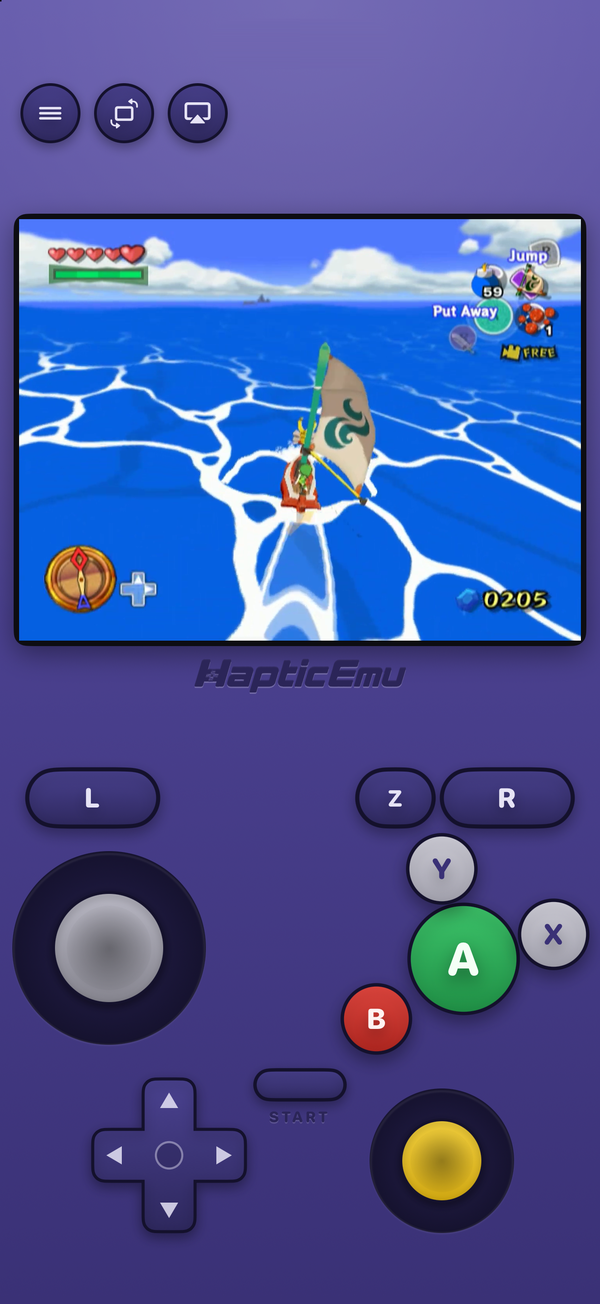
On iPhone, the GameCube story is all about working around a missing JIT. On Android it's simpler. Dolphin, the open-source GameCube emulator, has had an official Android app on Google Play for years, and Android lets emulators use the JIT recompilers that make the GameCube practical on a phone. So the question for a GameCube emulator for Android isn't "can it be done?" but "which app, which files and which phone?"
Haptic Emulator now plays the GameCube on Android as well, on Dolphin's own core. Here's how it fits, and what to expect.
What you need
- An Android phone on Android 9 or later, with a 64-bit ARM chip. That's nearly every phone sold since about 2019, though for GameCube a recent phone matters far more than the minimum — more on that below.
- Haptic Emulator from Google Play. Free, ordinary install: no APK, no "unknown sources".
- A backup of a GameCube disc you own, as an
.rvz,.gcz,.gcmor.cisofile.
No BIOS, no IPL dump, no system files.
The one catch: .iso isn't accepted yet
Many GameCube backups are .iso files, and Haptic doesn't accept those for GameCube yet: PlayStation, PSP, Saturn and DOS games use .iso too, and the app can't yet tell a GameCube disc apart by its extension. Convert it to .rvz first. Dolphin does that on a computer, and its Android app can do it on the phone itself. RVZ is lossless and usually much smaller than the 1.4 GB .iso, which your phone's storage will appreciate. Our RVZ guide walks through the conversion.
Dolphin or Haptic: which GameCube emulator for Android?
We make Haptic, so weigh this accordingly. But the honest answer is that the two are less rivals than two ways of using the same engine: Haptic's GameCube support is built on Dolphin's core.
Dolphin is the reference. It has been reproducing the GameCube since 2003, the Android app is free and open source, and it's the official build from the Dolphin project. It plays Wii games as well as GameCube, it takes .iso files directly, and it has settings for nearly everything: graphics enhancements, per-game configuration, controller mapping. In 2026 it added NetPlay on Android, too. If you want Wii games, higher resolutions or every option there is, get Dolphin.
Haptic is for people who'd rather not configure anything. You import a game, it lands on a GameCube shelf with its cover art, you press play, and the on-screen controls are shaped like the GameCube pad. Every press answers through the phone's vibration motor. And the GameCube sits in the same app as 25 other systems, from the NES to the PSP, 3DS and Dreamcast, with one controller setup for all of them.
The honest trade
Haptic's GameCube is deliberately narrow: no Wii, no upscaling, no cheats for GameCube, and .iso files need converting first. If any of those matter, Dolphin is the better GameCube app today. Haptic's bet is that most people want their GameCube games to start without a tutorial, next to everything else they own.
Dolphin and Haptic aren't the only names you'll come across. For RetroArch's Dolphin core, the old MMJR forks and the copycat apps, see the best GameCube emulators for Android, compared.
Getting started: the one-minute part
- Install Haptic Emulator from Google Play. Nothing to configure first.
- Tap import and pick the
.rvzwith Android's file picker, or share it into Haptic from Files, a browser download or a cloud drive app. - Let it file itself. The game lands on the GameCube shelf with its box art.
- Press play. The GameCube pad loads: control stick, C-stick, A, B, X, Y, Z, the L and R triggers, START and the small cross.
The free version holds a handful of games in its library; Haptic Pro lifts the limit and adds unlimited save states, fast-forward and batch import, which helps when you're bringing over a whole shelf of discs.
What the JIT changes
The GameCube's processor is an IBM PowerPC chip, and your phone's is ARM. An emulator can bridge that in two ways. An interpreter works out each PowerPC instruction as it meets it, every time. A JIT recompiler translates a block of the game's code into ARM instructions once and then runs the translation, which is far less work.
Apple doesn't allow App Store apps to use a JIT, so on iPhone Haptic runs the GameCube on Dolphin's Cached Interpreter. Android has no such rule, so here Haptic runs Dolphin's JIT, the same way Dolphin itself does. That's the biggest single difference between the two versions of the app, and it's why the GameCube is a more comfortable fit on a capable Android phone.
Which phones run it well
Even with a JIT, the GameCube is one of the most demanding systems in the app: a sixth-generation console with a real 3D graphics chip. Phone tiers matter more here than almost anywhere else.
- Recent mid-range and flagship phones — Snapdragon, Dimensity, Tensor or Exynos — run GameCube best.
- Older and budget phones fare better with lighter games, and can slow down in the busiest 3D scenes. For comparison, 8- and 16-bit consoles, the GBA, DS and PS1 run on almost anything.
- The first time an effect appears, there can be a brief hitch while the phone prepares it. It's cached afterwards, so the same moment is smooth next time.
We'd rather say that than promise full speed everywhere. Haptic is free, so the quickest way to know how a game runs on your phone is to try it.
The pad, controllers and the TV
The GameCube controller was an odd shape and its games were built around it, so Haptic's skin follows it: the control stick where your left thumb rests, the small cross below it, the big A button with B, X and Y around it, the yellow C-stick, and Z beside R. In portrait the controls sit under the picture like a console pad; turn the phone sideways for a landscape layout. You can rearrange them in the layout editor.
For anything that leans on the shoulder buttons, a real controller is nicer. PlayStation and Xbox controllers and other Bluetooth or USB gamepads work, with the left stick as the control stick, the right stick as the C-stick and the triggers as analog L and R. Haptic handles up to four controllers, each with its own button mapping.
With Haptic Pro you can also play on a TV: connect a USB-C to HDMI cable or cast from Android's Quick Settings, and the game moves to the big screen while the phone becomes the controller.
What doesn't work
- Wii games. Haptic is GameCube-only and refuses Wii discs at import, in any format. Dolphin plays them.
- Plain
.isofiles, for now. Convert them to.rvzfirst. - Upscaling. GameCube games render at the console's own resolution in Haptic.
- Cheat codes aren't offered for GameCube, though they are for several older systems.
- Game Boy Advance link features, the ones that needed a GBA plugged into the GameCube.
In-game memory card saves just work, and like your game files they stay on the phone and are never uploaded. Android's Google backup doesn't include Haptic's data, so use the app's own export or backup to keep a copy. Save states are there too, unlimited with Haptic Pro.
Is it legal?
Emulators are legal software, and Google Play carries plenty of them, Dolphin included. What matters is where the game comes from. Haptic ships no games, no disc images and no BIOS files, and has no way to find them: it plays backups of discs you own. Making that backup is the part you do yourself.
For the curious (optional)
The GameCube launched in 2001 with a 485 MHz IBM PowerPC processor called Gekko, an ATI graphics chip called Flipper, and games on 1.5 GB mini discs. It drew at 640×480. Nearly every GameCube emulator you'll find, on any platform, is built on Dolphin's work, including this one. On Android the JIT handles Gekko; Flipper's effects are rebuilt as shaders on your phone's GPU, which is why both a fast CPU and a capable graphics chip help, and why a game's first few minutes can have a hitch or two that later play doesn't.
Frequently asked questions
Should I use Dolphin or Haptic for GameCube on Android?
Is Dolphin on Google Play?
Why doesn't Haptic open my .iso file?
Does Haptic use JIT for GameCube on Android?
Which Android phone do I need for GameCube?
Does Haptic play Wii games, or need a BIOS?
The GameCube, and 25 more.
Haptic Emulator runs 26 retro systems on Android phones — free to play, and it ships no games: it plays the ones you already have.


Free on Google Play · Android 9 and later · 26 systems